Sunday, June 28, 2015

Helsinki, a summer destination

The Lutheran Church
Helsinki is an underrated destination due to the fact that it has to compete with two heavy weights: Stockholm and Copenhagen. Nevertheless, the city status is changing thanks to its good flight connections with Asia, in particular Japan. It was founded by the Swedish in the XVI century and it became capital of Finland in the XIX century when the country was under Russian occupation . The Russians wanted that the city to look similar to St. Petersburg so the German architect Carl Ludwig Engel was hired for the job. The result is a neoclassical city center with a noteworthy Russian footprint. Even though Finland is one of the three countries that share the Scandinavian peninsula, the country is less "Scandinavian" and much closer to the Nordic Baltic states, in particular Estonia. 

Summer is the best time to visit Helsinki, I say it is the only time I would dare to visit the city. Even during summer, you might experience temperatures below 15 degrees, so bring a light jacket for those cold evenings. Helsinki layout is clear and modern, very easy to walk. The historical center is very small and can be done in one morning. There are two big churches that are very close to each other. One  is the Lutheran Cathedral, in the Senate Square, beautiful from the outside and  austere and delicate from the inside. It is surrounded by neoclassical administrative buildings. The Uspenskin Cathedral is an hill facing the port, the biggest Russian Orthodox church outside Russia with very ornamented interior. These two churches represent the past of Finland: Sweden and Russia.

Russian Orthodox Church

In the Port area you will find the Esplanade, a small urban park that is located between two main streets. This is point zero in Helsinki, the place to meet people or to start a new journey. There are several outrageously expensive cafes, restaurants and design boutiques for those who have deep pockets or enjoy window-shopping. At the end of the Esplanade there is an open-air market where you could eat local food, buy fruit or kitsch souvenirs. Near the open market there is the Old Market Hall, a very "touristic" attraction with local and foreign products with very high prices.

From the Port you could take a boat to the Soumenlinna Fortress. This military base was built by the Swedes to defend Finland from the Russians and it is located in an small island in front of Helsinki. It is an UNESCO world heritage site and an excellent daytrip on a sunny day. You can enjoy outdoors or visit several museums and landmarks. There are cafes and restaurants on the island. For those who are really brave, you could take a bath in the cold waters of the Soumenlinna beach.

Arriving to the Soumennlinna Fortress
Things not to miss in Helsinki is the design district, where there are plenty of stores with Scandinavian design, the Rock church, a church carved in stone, the Kallio and the Johannes churches (one is Art Nouveau, and the other Neo-gothic), the Kampi Chappel of Silence, and the impressive Central Railway Station (also Art Nouveau).  Definitely, you should make an effort to see some of the work of Alvar Aalto (e.g. Finlandia Hall, the House of Alvar Aalto, the Academic Bookshop).

Kallio Church

Helsinki Central Railway
Helsinki has many museums, I had the opportunity to visit two of them: The Ateneum Art Museum (two years ago) and Kiasma (this year). The Ateneum has the ideal size. When I visited the museum, they had plenty of Japanese paintings, interesting Finish and Swedish classical work of art, and an exhibition of the art from the former Imperial Palace. Kiasma is a contemporary Art Museum. The building itself is an architectural masterpiece. Kiasma only has temporary exhibitions. When I visited the museum they had one called "Elements" about art and its relationship with nature, another one called "Face to Face" about portraits in contemporary art; one exhibition about the New York photographer Robert Mapplethorpe, and finally one about Ismo Kajander (a Finish artist).

Atrium of Kiasma, Helsinki
Helsinki has plenty of parks, lakes and places to enjoy nature. A good idea is to pick one day and do nothing except walk and admire the elegance of the city. Eating out is not an easy task in Helsinki. First, Helsinki is as expensive as Paris or even more. A margherita pizza could cost you 14 euros. My recommendation is to stay in a place with kitchen to save money. I really enjoyed my stay in Hostel Domus Academica. It is a student residence that during summer becomes a Hostel. It is well located, you have your own kitchen and bathroom. For me the best place for those who travel with limited budget. If you want to enjoy Finnish cuisine, I give you two options: an excellent buffet at affordable prices, Konstan Molja. Really good meat dishes, especially the lamb. For the second option, if you want to impress someone, go to Ateljé Finne, and put at least 100 euros in your pocket for a dinner of two. A good cafe is Cafe Erkberg, you will find excellent coffee and cakes. They also serve breakfast. Supermarkets are a great option to save money; some of them have salad bars. While you are in the supermarket buy Fazer, the local chocolate brand. I have lived three years in Belgium, and I can say without a doubt, that Fazer is as good as a Belgian or Swiss chocolate.


Some tips that  you should keep in mind when visiting Helsinki. Alcohol is extremely expensive, to the point of making you cry. Some people in Helsinki take the ferry to Tallinn just to buy beer. A local brewery is Bryggeri, with a decent local selection. If you come during summer, avoid the midsummer holiday (it is usually close to the summer solstice). Almost everything is closed. People leave the city towards the country side. Maybe it is a good idea to do a daytrip to Tallinn during those days (double check before your departure since Tallinn also celebrates the solstice although usually they move the date to avoid coincidence). One final tip: Finnish people seem quiet and calm, soft-spoken and tolerant, however, do not get confused, when they are upset you will not want to be near them: respect the queues and avoid stepping on the bicycle lane.

There are many things that I did not cover in this article, like Stockmann, the Arabia factory etc. I leave them to you to discover. If you plan your trip well, you could visit Helsinki without expending a fortune. It is a matter of sticking to the budget as much as possible while allowing some indulgences. For me, Helsinki is an unforgettable beautiful experience that I would like to repeat again.


Thursday, April 2, 2015

Trier, the oldest city in Germany


Augusta Treverorum is the Latin name of the oldest city in Germany, Trier. It was one of the most important cities of the Roman Empire, Imperial Residence and almost capital of the Western Roman Empire under Constantine the Great. The city conserves several archaeological sites and Roman monuments as witnesses of its past glories. Trier is also the birthplace of Karl Marx, one of the most influential thinkers of the XIX century. Surprisingly, a city with such historical background seems forgotten by the general public. In my recent visit to Trier, I can attest that it has been spared from mass tourism. The reason behind this oddity is that Trier is not well communicated with the rest of the world. The two airports close to Trier are Luxembourg (actually another country) and Hahn (Small regional airport in Germany). Of course, you could also reach Trier by train but even though, the city is probably not in the top of the list of a regular traveler.

Evidently, Trier's main attractions are the monuments linked with its Roman past. Porta Nigra is one of the most remarkable ones. It was the gate of the city in Roman times. The name means "black door" given the color of the stone used for its construction. You can climb it (I paid two euros). Although there are very few things to see inside, the views of the city are completely worth it. The next big attraction is Trier's Cathedral. The church was built from the remaining parts of an ancient temple built by Constantine the Great. The building is austere from outside and beautiful inside and contains many relics including the holy robe wear by Jesus. For a small fee you can enter the treasure chamber which contains several valuable liturgical objects. There is a beautiful cloister next to the church that you can also visit. Next to Trier's Cathedral is the Church of Our Lady, the oldest Gothic church in Germany. What I like about this church is its circular shape, unusual for this kind of constructions. These three monuments are UNESCO World Heritage Sites.

Other world heritage sites worth mentioning are the Imperial Throne Room , the Roman baths, the Roman amphitheater, and the Roman bridge. The Imperial Throne was transformed into a church (a Basilica) that was severely damaged during the Second World War. For the reconstruction, it was decided to throw out all the ornaments and statues that were added since its foundation and leave the place as close as possible to the Roman period. Next to the church is the splendid Electoral Palace built in Rococo style. I could not visit the interior of this palace but from outside you can enjoy a romantic view that includes a beautiful garden. In front of the Palace there is the Rhineland Museum, which has one of the most important collections of Roman archaeological objects in Germany (I think only Cologne has a larger collection). The museum is huge, it has many interesting artifacts, but it is not "tourist friendly". since not all the signalling are translated to English. Even though, it is a must in Trier, specially for its collection of funerary monuments (some of them conserve their original paint)  and the exquisite mosaics.

Porta Nigra

Trier's Cathedral

Imperial Throne Room
Electorate Palace
Rhineland Museum

Trier has another thing in common with Rome; it is the burial site of an apostle: Saint Matthias. He was the apostle that replaced Judas Iscariot, although he was not handpicked by Jesus. Saint Matthias remains are in a humble tomb inside the Abbey of Saint Matthias. The Abbey is outside the city center, you need almost 20 minutes walking to get there. Nevertheless there is a bus that runs frequently from the Abbey to downtown. The interior of the church is modest, you would never think that there is an Apostle buried inside. The church of Saint Paulin is the opposite of modesty, it is a Baroque gem. The interior reminds me some of the churches that I have seen in Austria. Definitively, it is worth to take some time and visit this place. Trier has also the Karl Marx museum, but I did not have time to visit this museum. 

Saint Matthias Tomb
Saint Paulin Church
If you are hungry, I recommend two places in Trier: Kartoffel Restaurant and Zum Domstein. Both places serve local cuisine. In the first one, its specialty is the dishes made with potatoes. Nevertheless, I had a Wien Schnitzel there and it was outstanding. The second restaurant has the bonus of a  "Roman menu" for those who want to eat as in the Roman times. As usual in Germany, the Konditoreien (bakeries) are a must. You should also try the Riesling wine while in Trier as much as possible. 

I recommend to stay in Trier no more than three days. From Trier you can also visit Luxembourg city, Metz (In France, highly recommended, I made a review about this place), and Saarbrücken (Germany). 


Saturday, February 21, 2015

Oviedo, one of the most beautiful cities in Spain


Oviedo is a remarkable city. The city frequently wins the golden broom contest, as one of the cleanest cities in Spain. As a matter of fact, the city has earned the platinum broom, the highest distinction available. It is as if the whole city has OCD. Everything seems pristine. Furthermore, there are people that  complain about the fact that "in the past it was even cleaner" and that the there is a relaxation of the norms. Oviedo has this "old money vibe", the old ladies wear their fancy fur coats to have a coup of coffee in the late afternoon, the streetlights are old fashion, five lights on a single post and the city has an excellent Opera venue. There are public art displays everywhere. Oviedo was once a capital of a Kingdom, a fact that still determines the character of the city today.  

Oviedo played an important role in the Christendom. The first pilgrimage towards Santiago de Compostela started in Oviedo. One of the main attractions of the  city is the Gothic Cathedral of San Salvador. It costs 7€ to visit this Cathedral, a little bit pricey but in my opinion it is worth it. The building has the holy chamber, an UNESCO world heritage site that contains the Sudarium of Oviedo, a piece of cloth with blood steins that allegedly covered the face of Jesus when he died. It is different from the Turin's shroud because the former was used when Jesus was taken down from the cross while the shroud was used in his burial. 

Photo taken without flash. These lights were inside the chamber

Oviedo has many churches in addition to the Cathedral. It is worth to mention the three pre-Romanesque churches that are also UNESCO world heritage sites. Santa María del Naranco and San Miguel de Lillo are relatively close to each other in the outskirts of Oviedo. Unfortunately, the opening times are very limited, I have never had the chance to see these churches inside. The other church is San Julian de los Prados, which is at walking distance from downtown Oviedo. You cannot take photos inside the church since the wall paintings are very fragile. The church was built in the IX century and it has a "Byzantine" aura.  Another beautiful church in Oviedo is the Basilica San Juan el Real, which was built at the beginning of the XX century and it has the dubious honor of being the place where the tyrant Franco got married. 

In addition to the churches, Oviedo has an excellent and free Museum of Fine Arts. The museum is inside a beautiful building that looks like an ancient palace. The highlights of the museum are the apostles painted by "El Greco" as well as the exquisite Zurbaran: Christ on the Cross. You need approximately 2 hours to see the permanent exhibition, although when I went, one side of the building was closed for reparations. Oviedo has also several public art objects . It is worth to mention the sculpture made by the Colombian artist Botero, the sculpture made by Eduardo Urculo and  the "touristic" statue of Woody Allen (which frequently losses its glasses). 

Santa Maria del Naranco

San Julian de los Prados

Zurbarán: Christ on the Cross 

One of the biggest pleasures of being in Oviedo is walking and observing the beautiful façades of the buildings. of the city's historic quarter. These buildings usually have glazed balconies and decorated lintels and columns. You should not miss the Campo de San Francisco (park), la calle Uría, the Constitution Square as well as "El Fontán" Market. This is a mandatory stop for those who want to buy local products.

Speaking about products, the gastronomy of Asturias is one of the best in Spain. The most famous local dish is "La Fabada Asturiana" which is essentially a stew made with white beans and pork meat (mainly chorizo and black pudding).. Another variation is "Pote Asturiano" which has potatoes and collard greens. I recommend to have Fabada or Pote only for lunch break, since these meals are quite heavy. Asturians love meat, especially pork. A local specialty is "bollo preñao" which is a bread cook with a chorizo inside (bollo=bread, preñao=pregnant). You could also  have for lunch cachopo which are two steaks forming a sandwich with ham and cheese inside (sort of a Cordon Bleu). These steaks are breaded and then they are covered with a heavy sauce, making one of the most caloric dishes I have ever tried in my life. Of course, cachopos are usually served with french fries. Castillian food is widely available in Oviedo, there are several restaurants that offer "lechazo" which is basically unweaned lamb.

Regarding desserts my recommendation is to visit as much as you can la confitería Rialto. They made the famous "moscovitas" which are an almond pastry covered with chocolate. You could also try the carbayones which are also made with almonds ( a sort of small cake with frosty).  Sidra (cider) is the main beverage in Asturias. The cider is poured in a glass in a very sophisticated manner, and they only pour a little, because you are supposed to drink it all at once. The reason is the bubbles made during the "escanciado process" give a distinct flavor. According to the locals it does not taste the same if you have several sips instead of drink all at once. Before leaving Asturias, you should buy chorizo as well as cheese. There are different varieties of local cheese in Asturias but the most famous ones are Cabrales (extremely strong blue cheese), Gamonedo (mild blue cheese) and Afuega l'pitu. (cow's milk cheese sometimes with red pepper). These cheeses have protected designation of origin.

Culis Monumentalis by Eduardo Úrculo (no pun intended)

Beautiful façades in Oviedo

The traditional Carvayones of Oviedo

You can spend a whole week in Oviedo. The reason is that this city could be your base to explore other destinations inside Asturias. The cities of Gijón and Avilés are located at less than an hour by bus. The coastal city of Gijón is relatively bigger than Oviedo, less opulent, with a younger vibe. On the other hand, Avilés is a very small town, the perfect city for a daytrip with a quaint historical center. Additionally you can also visit smaller coastal towns such as Ribadesella during summer if you want to practice water sports. Finally, Asturias has the national park "Picos de Europa" for those who like nature.


Monday, January 26, 2015

Leuven, The College Town of Belgium


Leuven is a small city less than thirty minutes from Brussels. It is a college town like Cambridge or Oxford in the UK or Cambridge in the USA. Life in Leuven swirls around the oldest university in Belgium, the Katholiek Universiteit Leuven. KU Leuven is not only the oldest and the biggest university in Belgium but also one of the best academic institutions in the world. In my opinion, Leuven is a masterpiece, that combines many architectural styles, being the Brabantine Gothic the most remarkable. 

The journey to discover Leuven starts at the newly renovated Leuven railway station. It is one of the rare cases where modern and old architecture fit harmoniously. You can take a direct train towards the airport from this station. Outside the station there is one of the most important streets in Leuven, the Bondgenontenlaan. The street is filled with boutiques, cinemas, restaurant and of course beautiful buildings. If you continue walking straight, you will get  to the Grote Mark, Leuven's core. 

I consider the Grote Markt an open air museum. The jewel of the crown is the town hall (in the picture above). This beautiful building is breathtaking and it is a good example of Brabantine Gothic. To visit the town hall interior you need to book a tour at the tourist information center that is in the street next to the town hall (Naamsestraat). They only offer one tour per day at 3:00 p.m. but this might change, check this link for more details.

St. Peter's Church is another magnificent example of Brabantine Gothic. The church is located in front of the town hall although the main entrance is in the rear side of the Grote Markt. The interior reminds me of churches in Belgium such as the Antwerp Cathedral or the Cathedral of Brussels. The Grote Markt is the meeting point of the city, with many expensive cafes and restaurants.

Next to the Grote Marktis the Oude Markt, a student area filled with bars. Locals call this place "the biggest bar of the world." Well..., certainly there are plenty of bars to choose from. Another important square is Ladeuzeplein where you find KU Leuven main library. It reminds me of the Palace of Peace of the Hague. Unfortunately, I believe that this building can only be seen from outside unless you are a student.  There is a weird monument in front of the library: an insect on a needle. It is called "Totem" and it should have a "deep meaning" that I am still unable to grasp.


Leuven has an excellent Art museum, it is called M. The permanent collection of the M museum is eclectic and includes painting, sculpture and applied arts. Temporary exhibitions focus mainly on Comtemporary Art. It takes about two hours to visit the museum if you go at normal pace. Sometimes they organize activities inside the Museum, so I suggest to check their website for details.

One of the most charming places of Leuven is the Groot Begijnhof, in French the word is béguinage. A béguinage was a closed community of religious women that lived together in order to offer mutual support. A friend explained me that these women were mainly widows and unmarried females that did not want to pursue a pure monastic life. Today, the Groot Begijnhof of Leuven belongs to KU Leuven and it is part of the housing system of the university. The place is open to the public but it is a little bit far away from the city center. To reach the béguinage you need to go straight on Parijstraat which becomes Shapenstraat.  You need to remember that people live in this place, this is not a pure "touristic attraction."

Another cultural venue that is worth to check out is STUK. They have a nice cultural program that includes almost all the arts. The best time to visit STUK is during Docville, one of the most important documentary film festivals in Europe. If you like insightful documentaries about current issues this festival is a must.

There are plenty places for eating at Leuven. Unfortunately for most of them, I would give a miss. There are three kinds of restaurants, bad ones, expensive ones and bad and expensive ones. Their target is the rich parents that visit their kids once in a while.   However, if you go outside the Grote Markt ant the obvious tourist traps, you could eat very well.  My personal favorite place is Mangia e via. The best pizza outside Liège.

Leuven makes a great day trip. It is fun, young and it feels real, it does not seem like an amusement park. Definitively it is worthy. 

Tuesday, December 9, 2014

Monschau, A Christmas Market Destination


It is quite probable that you have never heard about Monschau. I mean, many people who live in Liège, which is the neighboring province in Belgium, don't know that this town exist. Monschau is a small village (less than 15,000 inhabitants), next to the Belgium-German border in an area called Eifel. If you don't own a car, it is very difficult to reach this village; you need a bus/train combination that is risky. However, Monschau has one of the most charming Christmas markets in Germany that is totally worth the effort. 

In my opinion, the best time to visit Monschau is obviously during Christmas. Nevertheless, the town has a castle (on a mountain), that apparently offers concerts of classical music in summer. There are a few attractions in the city. The main one is the Red House, which was a mansion that belonged to a rich merchant and it was built in the eighteen century. It is the most impressive building in the town; you can see how was the life of the wealthy people more than two centuries ago It has all the original furniture. Unfortunately you could only visit it between April and November. The best moment to visit Monschau is the last weekend of November when you can enjoy the Christmas market and visit the Red House. 


In addition to the Red house, there are several nice but small churches that are good to visit. The most interesting one is the protestant church that is connected by a small bridge. It is very small but I will say, it has a very warm feeling. In my opinion, the timber houses is what makes Monschau special. Monschau was spared for the destruction that took place during the World War II. I recommend to take some time to wonder and see the beauty of the town.

If you go for the Christmas market, there are several things that you should keep in mind. The markets are spread all around the town, You can find stands even inside some buildings. In addition to the traditional Christmas ornaments, you could find gourmet food and other specialty goods. The best souvenirs are Monschau Mustard (several varieties, the most delicious are the one with honey and poppy-seeds or the one with Riesling), bread (go to Hensch, people go there to buy bread made in stone oven), Printen, Elder-flower syrop (homemade) and several kinds of pastries with apple.  Try the mulled wine, the chocolate with alcohol, the kartoffelpuffer mit apfelmus (pankakes made of potatoes with apple sauce), champignons, and a large diversity of sausages.

If you do not own a car and your departure point is Belgium I will explain you how to get there. This only works on weekends and it is risky. If there is a delay in the train you might have to take a cab. Take a train to Eupen (you should arrive at least 5 minutes before 10 a.m.). In front of the train station there is street with a bus stop. The stop is in the same street but not exactly in front of the train station, you can see it from the window of the train if you are seated in the first wagons.  You need to take the 385 towards Monschau.  To go back, you need to take the same bus. The last departure is at 15:33. If you miss that bus, you can always go to Aachen and take the train there to Belgium (if you departure point is Belgium). However, I think the last bus to Aachen is at 19:25 (check Deutsche Bahn for details). It would be safer to go by car o with an organized excursion. Since I do not own a car, I took the risk every year, without problem. 


Thursday, December 4, 2014

Pamplona, beyond San Fermin

Monumento al Encierro

I have been traveling a lot lately, gathering new material for this blog. This post is about Pamplona, the capital of Navarra, Spain. This small town is well known worldwide due to the festivities of San Fermin. For those of you who have never heard of San Fermin I am including this link.

Tourists visit the city  during the festivities (6 to 14 of July), most of them get so drunk that probably don't even remember that they were in Pamplona. It is well known fact that many locals leave the city in July to avoid the crowds. I have been in Pamplona three times but never during San Fermin, so I do not know how crazy it could be. Nevertheless, I can assure you that Pamplona is a pleasant small city to visit outside the touristic season.

Navarra is part of the basque region that includes the Basque country in Spain and part of France (Bayonne, Biarritz and other towns). You could hear people speaking Euskera although less frequent than in Donostia (San Sebastian). Euskera is a very difficult language that does not come from Latin or any Germanic language.  Apparently it is a native language of the Iberian peninsula. Navarra was an independent country for many years and in one period of history the Kings of France were also crowned Kings of Navarra. This is probably one of the reasons that explain why the people of Navarra and the Basque country have a different status (Fueros) within the Spanish autonomic system. Pamplona in Euskera is Iruña.

Most of the city's medieval walls are still in place today. In my opinion it is one of its most important attractions. You can walk along the walls and admire these military structures and the parks that are next to them. Pamplona has several churches that are worth visiting. Of course the principal is Pamplona's Cathedral. In my opinion, I found the interior much more interesting than the exterior.The interior is Gothic while the exterior seems Neoclassic, they do not match at all. The main square, la Plaza del Castillo, is the best place to sit, relax, grab a coffee and eat pintxos while you watch the world go by  (I enjoyed Cafe Iruña, despite some of the bad reviews in Tripadvisor, apparently Hemingway also liked this place).

Plaza del Castillo
Tomb of the King of Navarra Charles III and his Wife inside Pamplona's Cathedral

Pamplona has a small and eclectic Art museum. Most or the Art correspond to the Romanesque and Gothic styles (there is also a  beautiful Goya inside). As you can imagine, in medieval times, artists were focused in expressing religious sentiments, sometimes with  very sadistic overtones, consider yourself warned. Pamplona has a close connection with the Catholic church. For example, Josemaría Escrivá de Balaguer, the founder of the Opus Dei movement, was also the founder of the Universidad de Navarra, one of the best private universities in Spain.


Another important venue that deserves a visit is the Gayarre Theater.  If you know Spanish (or Euskera) it is a good place to watch a play or an spectacle. Finally, I have always eaten very well in Pamplona (A good restaurant is Otano). The pinxos (tapas) are as delicious as in San Sebastian but cheaper. You could always  find good wine that marry well with the food, probably due to the proximity of La Rioja. My recommendation is to visit Pamplona for maximum two nights. You could easily spend in the area four to five nights, if you visit other cities. For instance, the bus between San Sebastian and Pamplona takes one hour and San Sebastian is a great choice. One final suggestion: avoid talking about politics, it is better to remain neutral. 

Wednesday, November 5, 2014

Aachen, the former capital of Europe


Aquisgrana, Aquisgrán, Aix-la-Chapelle, Aachen, a city that has many names and a long history. It was my inspiration for starting this blog about underrated cities. Aachen was the chosen city of Charlemagne to expand his European Empire, making the city the second historical "capital of Europe" (after Rome) and the place of coronation of 31 German Kings.  The city is located close to Maastricht (Netherlands) and Liège (Belgium) in an area called Meuse-Rhine Euroregio. 

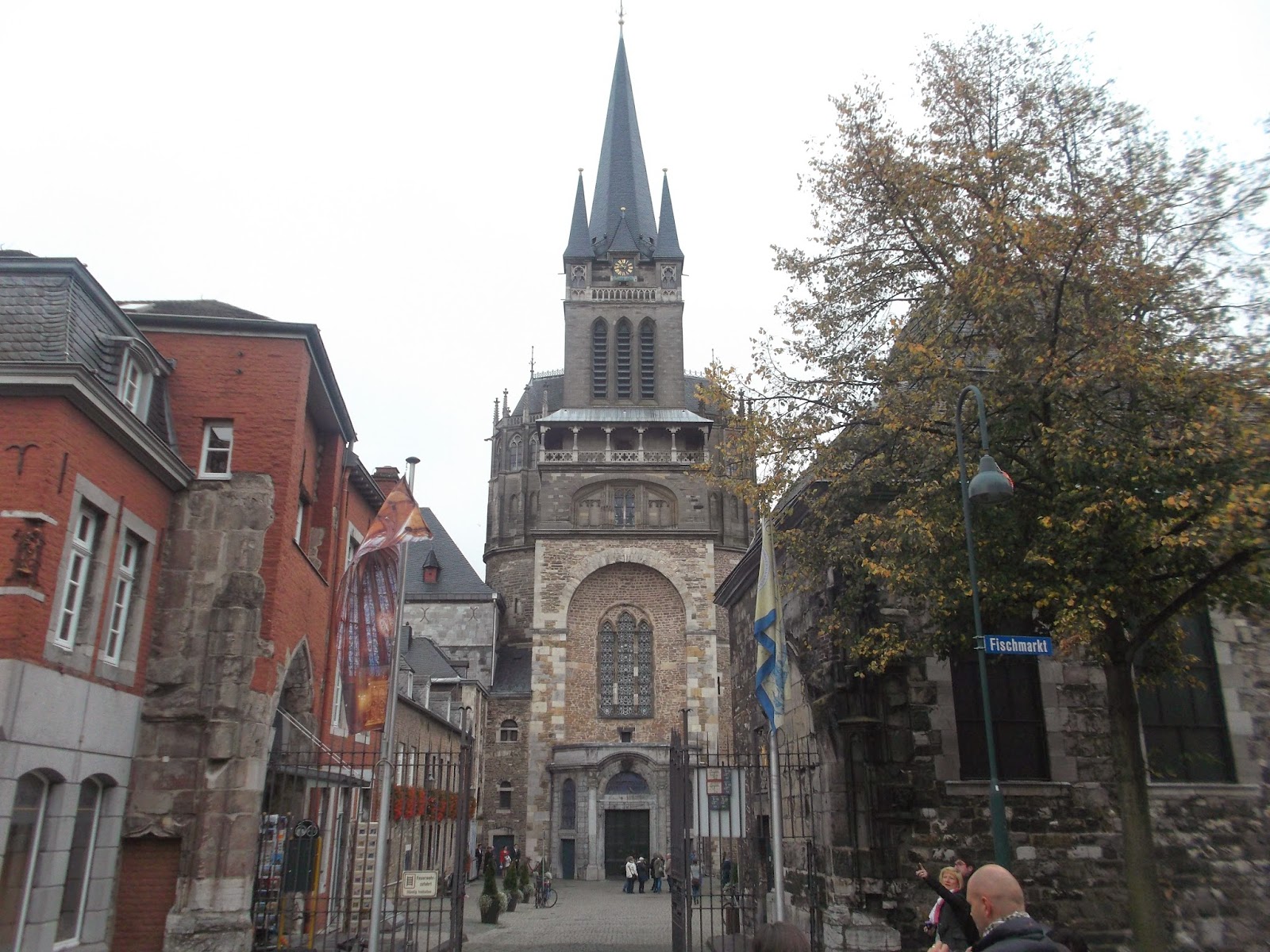
Charlemagne built his palace in Aachen and filled it with treasures. Although the palace no longer exists, its former chapel became Aachen's Cathedral. During the middle ages, the most important treasures were relics that belonged to Jesus, his disciples or his family. Well, believe it or not, Aachen has Jesus'diapers , Jesus'underwear (loincloth), Virgin Mary's dress and the blanket used to hold John's head. How these items came there,  it is a mystery for me. These sacred objects are under custody inside the Cathedral and are only displayed in a ceremony that takes place every seven years. You could also find a fragment of Peter's chain that was used to hold him in Rome, a piece of the sponge used for giving water to Jesus, many Saint's bones and body parts (yuppie!). Charlemagne's remains are in a golden sarcophagus also inside the Cathedral. Most of the Cathedral's treasure is displayed in a separate building and it is one of the largest of the Christendom. The church was built in a byzantine style and it is a Unesco World Heritage. 

This is a "romantic" representation of Charlemagne (according to the audio guide, Charlemagne did not look like that)
Cathedral's interior. Observe the byzantine mosaics of the arcs
In addition to the Cathedral's treasury, Aachen has two art Museums (Suermondt-Ludwig Museum, Ludwig Forum), the Couven Museum (an old mansion transformed into a museum) and the International News Paper Museum. You can also visit the Town Hall that was formerly part of the  Charlemagne's palace. My favorite museum is the Ludwig Forum. This institution is located in a former factory built in a Bauhaus style and it has an amazing art collection from the twentieth century. Recently I realized t that the museum is linked with the Ludwig Museum in Cologne. The Ludwig Forum has three floors although the last two are closed (apparently for renovations). Nevertheless, the lions's share is in the first floor and the basement.

The Ludwig has an incredible collection of Pop Art, (Roy Liechtenstein), graffiti art from the New York of the 80's, well-known names as Ai Weiwei among others. The collection is huge and changes every season. Some of the art in the Ludwig is intended to shock the visitor, thus consider you warned. Surprisingly, this museum is usually empty (although the last time I visit the Ludwig there were more than 10 people). The reason is simple, it is located outside Aachen's downtown (20 minutes walk) and honestly it is not well advertised by the tourism office. For those of you who like modern art, this is a mandatory stop. The museum has also a large video collection. One of my favorites is Susan Pitt's Asparagus (1978), a kind of psychological film with plenty sexual symbolism. The film is projected in a small room with three movie seats. In front of you there is a miniature theater that has the screen where the film is projected. I have always felt weird there, as if I was in David Lynch's "silencio" theater (For those of you who saw Mulholland Drive).

Town Hall of Aachen, former part of Charlemagne Museum

Some of the art work is provocative
Hasta la Victoria Secret?
Never go shopping with an empty stomach
In addition to the museums, Aachen has interesting neighborhoods (Frankenberger Viertel, Burtscheid), a great diversity of restaurants (my favorites are Aachener Brauhaus and Karibik colombian food) and of course a wonderful Christmas market.  It is one of the best I have been. During Christmas you could eat flammkuchen, champignons, special sausages among others special treats and drink hot wine, punch or chocolate. Aachen's main local product is the "Aachener printen" which is similar to the Lebkuchen. It is a soft sweet cookie (or bread?) that you could buy covered in dark, milk or white chocolate. Printens are available the whole year, but they are must in Christmas. The main companies producing printen are Aachener Printen and Nobis. An insider tip is that there is a Kaufhof store in Aachen where you could buy holunderblütensirup and Händlmaier mustard. However, the best mustard is Monschau's sweet mustard; you could find it in the butcher's shop Fleischerei Gerrards (much more easier than going to Monschau).

I have not written about Aachen's spa tradition. I am not a big fan of spas but for those of you who like these venues, Aachen has a long tradition of thermal baths that started in the Middle ages. The most well known spa is the Carolus.

Aachen is a gem to be discovered, well connected (Paris, Cologne, Brussels, Liège, Maastricht among others) and it is  a very relaxed city. Definitively one of the most underrated cities that I have visited.