Monday, January 26, 2015

Leuven, The College Town of Belgium


Leuven is a small city less than thirty minutes from Brussels. It is a college town like Cambridge or Oxford in the UK or Cambridge in the USA. Life in Leuven swirls around the oldest university in Belgium, the Katholiek Universiteit Leuven. KU Leuven is not only the oldest and the biggest university in Belgium but also one of the best academic institutions in the world. In my opinion, Leuven is a masterpiece, that combines many architectural styles, being the Brabantine Gothic the most remarkable. 

The journey to discover Leuven starts at the newly renovated Leuven railway station. It is one of the rare cases where modern and old architecture fit harmoniously. You can take a direct train towards the airport from this station. Outside the station there is one of the most important streets in Leuven, the Bondgenontenlaan. The street is filled with boutiques, cinemas, restaurant and of course beautiful buildings. If you continue walking straight, you will get  to the Grote Mark, Leuven's core. 

I consider the Grote Markt an open air museum. The jewel of the crown is the town hall (in the picture above). This beautiful building is breathtaking and it is a good example of Brabantine Gothic. To visit the town hall interior you need to book a tour at the tourist information center that is in the street next to the town hall (Naamsestraat). They only offer one tour per day at 3:00 p.m. but this might change, check this link for more details.

St. Peter's Church is another magnificent example of Brabantine Gothic. The church is located in front of the town hall although the main entrance is in the rear side of the Grote Markt. The interior reminds me of churches in Belgium such as the Antwerp Cathedral or the Cathedral of Brussels. The Grote Markt is the meeting point of the city, with many expensive cafes and restaurants.

Next to the Grote Marktis the Oude Markt, a student area filled with bars. Locals call this place "the biggest bar of the world." Well..., certainly there are plenty of bars to choose from. Another important square is Ladeuzeplein where you find KU Leuven main library. It reminds me of the Palace of Peace of the Hague. Unfortunately, I believe that this building can only be seen from outside unless you are a student.  There is a weird monument in front of the library: an insect on a needle. It is called "Totem" and it should have a "deep meaning" that I am still unable to grasp.


Leuven has an excellent Art museum, it is called M. The permanent collection of the M museum is eclectic and includes painting, sculpture and applied arts. Temporary exhibitions focus mainly on Comtemporary Art. It takes about two hours to visit the museum if you go at normal pace. Sometimes they organize activities inside the Museum, so I suggest to check their website for details.

One of the most charming places of Leuven is the Groot Begijnhof, in French the word is béguinage. A béguinage was a closed community of religious women that lived together in order to offer mutual support. A friend explained me that these women were mainly widows and unmarried females that did not want to pursue a pure monastic life. Today, the Groot Begijnhof of Leuven belongs to KU Leuven and it is part of the housing system of the university. The place is open to the public but it is a little bit far away from the city center. To reach the béguinage you need to go straight on Parijstraat which becomes Shapenstraat.  You need to remember that people live in this place, this is not a pure "touristic attraction."

Another cultural venue that is worth to check out is STUK. They have a nice cultural program that includes almost all the arts. The best time to visit STUK is during Docville, one of the most important documentary film festivals in Europe. If you like insightful documentaries about current issues this festival is a must.

There are plenty places for eating at Leuven. Unfortunately for most of them, I would give a miss. There are three kinds of restaurants, bad ones, expensive ones and bad and expensive ones. Their target is the rich parents that visit their kids once in a while.   However, if you go outside the Grote Markt ant the obvious tourist traps, you could eat very well.  My personal favorite place is Mangia e via. The best pizza outside Liège.

Leuven makes a great day trip. It is fun, young and it feels real, it does not seem like an amusement park. Definitively it is worthy. 

Tuesday, December 9, 2014

Monschau, A Christmas Market Destination


It is quite probable that you have never heard about Monschau. I mean, many people who live in Liège, which is the neighboring province in Belgium, don't know that this town exist. Monschau is a small village (less than 15,000 inhabitants), next to the Belgium-German border in an area called Eifel. If you don't own a car, it is very difficult to reach this village; you need a bus/train combination that is risky. However, Monschau has one of the most charming Christmas markets in Germany that is totally worth the effort. 

In my opinion, the best time to visit Monschau is obviously during Christmas. Nevertheless, the town has a castle (on a mountain), that apparently offers concerts of classical music in summer. There are a few attractions in the city. The main one is the Red House, which was a mansion that belonged to a rich merchant and it was built in the eighteen century. It is the most impressive building in the town; you can see how was the life of the wealthy people more than two centuries ago It has all the original furniture. Unfortunately you could only visit it between April and November. The best moment to visit Monschau is the last weekend of November when you can enjoy the Christmas market and visit the Red House. 


In addition to the Red house, there are several nice but small churches that are good to visit. The most interesting one is the protestant church that is connected by a small bridge. It is very small but I will say, it has a very warm feeling. In my opinion, the timber houses is what makes Monschau special. Monschau was spared for the destruction that took place during the World War II. I recommend to take some time to wonder and see the beauty of the town.

If you go for the Christmas market, there are several things that you should keep in mind. The markets are spread all around the town, You can find stands even inside some buildings. In addition to the traditional Christmas ornaments, you could find gourmet food and other specialty goods. The best souvenirs are Monschau Mustard (several varieties, the most delicious are the one with honey and poppy-seeds or the one with Riesling), bread (go to Hensch, people go there to buy bread made in stone oven), Printen, Elder-flower syrop (homemade) and several kinds of pastries with apple.  Try the mulled wine, the chocolate with alcohol, the kartoffelpuffer mit apfelmus (pankakes made of potatoes with apple sauce), champignons, and a large diversity of sausages.

If you do not own a car and your departure point is Belgium I will explain you how to get there. This only works on weekends and it is risky. If there is a delay in the train you might have to take a cab. Take a train to Eupen (you should arrive at least 5 minutes before 10 a.m.). In front of the train station there is street with a bus stop. The stop is in the same street but not exactly in front of the train station, you can see it from the window of the train if you are seated in the first wagons.  You need to take the 385 towards Monschau.  To go back, you need to take the same bus. The last departure is at 15:33. If you miss that bus, you can always go to Aachen and take the train there to Belgium (if you departure point is Belgium). However, I think the last bus to Aachen is at 19:25 (check Deutsche Bahn for details). It would be safer to go by car o with an organized excursion. Since I do not own a car, I took the risk every year, without problem. 


Thursday, December 4, 2014

Pamplona, beyond San Fermin

Monumento al Encierro

I have been traveling a lot lately, gathering new material for this blog. This post is about Pamplona, the capital of Navarra, Spain. This small town is well known worldwide due to the festivities of San Fermin. For those of you who have never heard of San Fermin I am including this link.

Tourists visit the city  during the festivities (6 to 14 of July), most of them get so drunk that probably don't even remember that they were in Pamplona. It is well known fact that many locals leave the city in July to avoid the crowds. I have been in Pamplona three times but never during San Fermin, so I do not know how crazy it could be. Nevertheless, I can assure you that Pamplona is a pleasant small city to visit outside the touristic season.

Navarra is part of the basque region that includes the Basque country in Spain and part of France (Bayonne, Biarritz and other towns). You could hear people speaking Euskera although less frequent than in Donostia (San Sebastian). Euskera is a very difficult language that does not come from Latin or any Germanic language.  Apparently it is a native language of the Iberian peninsula. Navarra was an independent country for many years and in one period of history the Kings of France were also crowned Kings of Navarra. This is probably one of the reasons that explain why the people of Navarra and the Basque country have a different status (Fueros) within the Spanish autonomic system. Pamplona in Euskera is Iruña.

Most of the city's medieval walls are still in place today. In my opinion it is one of its most important attractions. You can walk along the walls and admire these military structures and the parks that are next to them. Pamplona has several churches that are worth visiting. Of course the principal is Pamplona's Cathedral. In my opinion, I found the interior much more interesting than the exterior.The interior is Gothic while the exterior seems Neoclassic, they do not match at all. The main square, la Plaza del Castillo, is the best place to sit, relax, grab a coffee and eat pintxos while you watch the world go by  (I enjoyed Cafe Iruña, despite some of the bad reviews in Tripadvisor, apparently Hemingway also liked this place).

Plaza del Castillo
Tomb of the King of Navarra Charles III and his Wife inside Pamplona's Cathedral

Pamplona has a small and eclectic Art museum. Most or the Art correspond to the Romanesque and Gothic styles (there is also a  beautiful Goya inside). As you can imagine, in medieval times, artists were focused in expressing religious sentiments, sometimes with  very sadistic overtones, consider yourself warned. Pamplona has a close connection with the Catholic church. For example, Josemaría Escrivá de Balaguer, the founder of the Opus Dei movement, was also the founder of the Universidad de Navarra, one of the best private universities in Spain.


Another important venue that deserves a visit is the Gayarre Theater.  If you know Spanish (or Euskera) it is a good place to watch a play or an spectacle. Finally, I have always eaten very well in Pamplona (A good restaurant is Otano). The pinxos (tapas) are as delicious as in San Sebastian but cheaper. You could always  find good wine that marry well with the food, probably due to the proximity of La Rioja. My recommendation is to visit Pamplona for maximum two nights. You could easily spend in the area four to five nights, if you visit other cities. For instance, the bus between San Sebastian and Pamplona takes one hour and San Sebastian is a great choice. One final suggestion: avoid talking about politics, it is better to remain neutral. 

Wednesday, November 5, 2014

Aachen, the former capital of Europe


Aquisgrana, Aquisgrán, Aix-la-Chapelle, Aachen, a city that has many names and a long history. It was my inspiration for starting this blog about underrated cities. Aachen was the chosen city of Charlemagne to expand his European Empire, making the city the second historical "capital of Europe" (after Rome) and the place of coronation of 31 German Kings.  The city is located close to Maastricht (Netherlands) and Liège (Belgium) in an area called Meuse-Rhine Euroregio. 

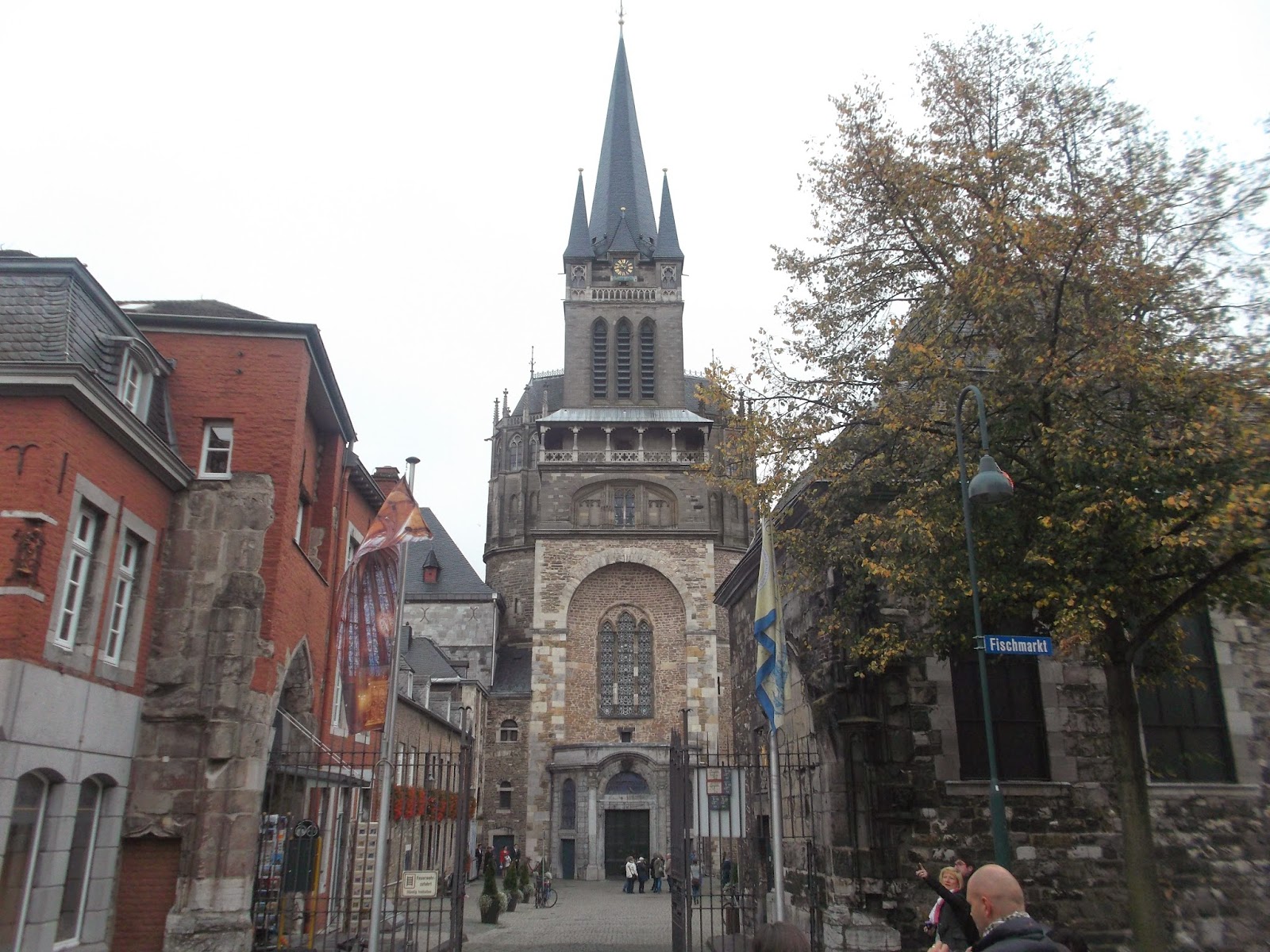
Charlemagne built his palace in Aachen and filled it with treasures. Although the palace no longer exists, its former chapel became Aachen's Cathedral. During the middle ages, the most important treasures were relics that belonged to Jesus, his disciples or his family. Well, believe it or not, Aachen has Jesus'diapers , Jesus'underwear (loincloth), Virgin Mary's dress and the blanket used to hold John's head. How these items came there,  it is a mystery for me. These sacred objects are under custody inside the Cathedral and are only displayed in a ceremony that takes place every seven years. You could also find a fragment of Peter's chain that was used to hold him in Rome, a piece of the sponge used for giving water to Jesus, many Saint's bones and body parts (yuppie!). Charlemagne's remains are in a golden sarcophagus also inside the Cathedral. Most of the Cathedral's treasure is displayed in a separate building and it is one of the largest of the Christendom. The church was built in a byzantine style and it is a Unesco World Heritage. 

This is a "romantic" representation of Charlemagne (according to the audio guide, Charlemagne did not look like that)
Cathedral's interior. Observe the byzantine mosaics of the arcs
In addition to the Cathedral's treasury, Aachen has two art Museums (Suermondt-Ludwig Museum, Ludwig Forum), the Couven Museum (an old mansion transformed into a museum) and the International News Paper Museum. You can also visit the Town Hall that was formerly part of the  Charlemagne's palace. My favorite museum is the Ludwig Forum. This institution is located in a former factory built in a Bauhaus style and it has an amazing art collection from the twentieth century. Recently I realized t that the museum is linked with the Ludwig Museum in Cologne. The Ludwig Forum has three floors although the last two are closed (apparently for renovations). Nevertheless, the lions's share is in the first floor and the basement.

The Ludwig has an incredible collection of Pop Art, (Roy Liechtenstein), graffiti art from the New York of the 80's, well-known names as Ai Weiwei among others. The collection is huge and changes every season. Some of the art in the Ludwig is intended to shock the visitor, thus consider you warned. Surprisingly, this museum is usually empty (although the last time I visit the Ludwig there were more than 10 people). The reason is simple, it is located outside Aachen's downtown (20 minutes walk) and honestly it is not well advertised by the tourism office. For those of you who like modern art, this is a mandatory stop. The museum has also a large video collection. One of my favorites is Susan Pitt's Asparagus (1978), a kind of psychological film with plenty sexual symbolism. The film is projected in a small room with three movie seats. In front of you there is a miniature theater that has the screen where the film is projected. I have always felt weird there, as if I was in David Lynch's "silencio" theater (For those of you who saw Mulholland Drive).

Town Hall of Aachen, former part of Charlemagne Museum

Some of the art work is provocative
Hasta la Victoria Secret?
Never go shopping with an empty stomach
In addition to the museums, Aachen has interesting neighborhoods (Frankenberger Viertel, Burtscheid), a great diversity of restaurants (my favorites are Aachener Brauhaus and Karibik colombian food) and of course a wonderful Christmas market.  It is one of the best I have been. During Christmas you could eat flammkuchen, champignons, special sausages among others special treats and drink hot wine, punch or chocolate. Aachen's main local product is the "Aachener printen" which is similar to the Lebkuchen. It is a soft sweet cookie (or bread?) that you could buy covered in dark, milk or white chocolate. Printens are available the whole year, but they are must in Christmas. The main companies producing printen are Aachener Printen and Nobis. An insider tip is that there is a Kaufhof store in Aachen where you could buy holunderblütensirup and Händlmaier mustard. However, the best mustard is Monschau's sweet mustard; you could find it in the butcher's shop Fleischerei Gerrards (much more easier than going to Monschau).

I have not written about Aachen's spa tradition. I am not a big fan of spas but for those of you who like these venues, Aachen has a long tradition of thermal baths that started in the Middle ages. The most well known spa is the Carolus.

Aachen is a gem to be discovered, well connected (Paris, Cologne, Brussels, Liège, Maastricht among others) and it is  a very relaxed city. Definitively one of the most underrated cities that I have visited.  

Tuesday, October 28, 2014

Bratislava deserves a second visit


I start with a confession: the first time I visited Bratislava I did not like it. It was in 2010 after visiting Vienna and Budapest. Therefore, I did not plan to revisit the city again. A friend of mine convinced me to give it a second chance. I went back in 2014 and I am glad I did. In my opinion, as long as you don't try to compare Bratislava with Vienna, Budapest or Prague, you will have better appreciation for the city. Bratislava is small, it does not have the overwhelming opulence of its bigger "sisters" but it makes a great daytrip destination and if by chance you need to take a flight from there do not hesitate to spend sometime wandering in the city. 

The main attraction of Bratislava is the old town. It is small, clean and beautiful. Prices in the old town are higher than in the rest of Bratislava, so it would be a good idea to venture outside the old town for lunch break. I found some interesting gargoyles "observing visitors" from the roof of the houses. On the edge of the old town, there is Bratislava's cathedral (St Martin's). The cathedral is beautifully decorated, it has an interesting treasure and  the choir has many creepy"monsters." You can also visit the church's  catacombs which is quite an experience, specially for the eerie feeling that you will have there.
He was watching me the whole time

The cathedral is next to a highway

This little fella is waiting for you inside the church with all his friends
There is a castle relatively close to the cathedral where apparently visitors could take good pictures of Bratislava;  however the tourist information desk was not to much enthusiastic about this attraction. In addition to the cathedral there were other churches that were worth visiting but the Blue church deserves a special mention. This secessionist building is at walking distance from the old town. The blue church is small and quite extravagant, it reminds me of the modernist buildings in Barcelona.


In addition to the churches, there is the Danubiana, museum of modern art, in the outskirts of the city. Unfortunately when I was in Bratislava the museum was closed. Apparently it has reopened recently. You could go by bus or by boat like the Tate Modern in England. A good  choice for lunch is the Pivoraská Restaurant. It is gastropub relatively close to the city center that offer good beer and local specialties (warning: a paradise for meat lovers). The Hungarian bakery franchise Fornetti is present in the city, it is very cheap and its turnovers are delicious.

If you take the train from Vienna to Bratislava, the train ticket includes the use of all public transportation in Bratislava for that day. I recommend to spend one morning or afternoon in Bratislava unless you visit the Danubiana museum or you take an early flight from Bratislava Airport, then you could stay a little bit longer (maximum one full day). Beware, that the bus that goes from the downtown to the airport is sometimes crowded. It is a good idea to go with extra time to the airport despite the fact that it is relatively close.

Bratislava is a small pleasant city with a lot of potential. It feels that the city is trying to find its niche. I believe it is the right track.

Tuesday, October 21, 2014

Ypres, 1914-2014


Ypres is a city that suffered tremendously during the first World War. It was in Ypres when chemical weapons were used for the first time (Yperite) and the city was completely destroyed after three important battles. Approximately half-million people died in the fields of Ypres from both sides, (mainly British and Germans, although I have found other reports with much higher numbers). The sheer size of total destruction would only be surpassed during the Second World War. After the war, the city was rebuilt, trying to look as close as possible as it was before the war. Today, Ypres is a tourist destination mainly for British nationals and history buffs. Although, I consider Ypres as an underrated destination, the city will attract a considerable influx of tourist due to the commemorations of the centennial of the WWI. 

I found Ypres quite charming small city. The main attraction is the Flanders Fields Museum. They did a commendable effort to explain the atrocities of the war in an interesting way. The museum is frequently visited by British students and by descendants and families of those who perished in the fields of Flanders.  The museum has a "soundtrack" which I found very sad and in combination with the emotive visitors could be too much for a sensible person. An acquaintance told me that it was produced by the British band "Tindersticks" specially for the museum. You could climb the tower inside the Museum and have a fantastic view of the city. 


One of the highlights of a visiting Ypres is the Last Post Ceremony that takes place every day at 8:00 p.m. at the Menin Gate Memorial. It is a very emotive ceremony to remember those soldiers who died for the freedom of Ypres. You need to be aware that every tourist in town will attend to this ceremony, so if you want to see "something" you'd better arrive very early. I went at 7:00 p.m. and it was already crowded. Despite the rudeness of some travelers, I will say that if you go to Ypres and do not go to this ceremony you are missing something special.

Ypres has beautiful churches and well kept military cemeteries. St Martin's Cathedral is an extraordinary example of the resilient spirit of the inhabitants of Ypres. I found the church beautifully restored and very solemn. Another interesting church is the St George Memorial Church. It is an Anglican church that also serves as a memorial for the fallen Commonwealth soldiers. It is decorated with gifts from the families and military divisions/institutions. Within the city limits there are two cemeteries that you could visit: Ypres Reservoir Cemetery (only from outside) and the Rampart Cemetery Lille Gate.


I suggest to spend one night in Ypres since it is relatively far away from Brussels. The best day is Saturday and it is even better if you could be there for the morning market. The market itself is an attraction and if it is sunny you could go to the restaurant In t'klein Stadhuis and ask for a delicious Rundsstoofvlees made with a Trappist Rochefort. You will not regret it. As it is customary in Belgium there are plenty of places when you could buy excellent chocolate. You could combine a visit to Ypres with a visit to Lille (one hour, eleven minutes) or Courtrai (thirty minutes). If you decide to go to Courtrai, there is a place where they sell burgers with spicy chocolate sauce! (Paul's Boutique). Ypres is an excellent destination, do not miss the chance to visit the city in this historical moment. 


Monday, October 13, 2014

Relax, You are in The Hague


The Hague is the perfect alternative for the frantic Amsterdam. If Amsterdam is crowded, cheerful, strident, the Hague is mellow, harmonious and much more sober. You will not find here the typical young crowd looking for drugs and "fun" (at least not much). Tourism in the Hague is oriented towards culture and relaxation. I have visited the city twice and it is one of my favorites. In my opinion, the best time to visit The Hague is summer when you can visit the Scheveningen beach  and enjoy good weather. 

The Hague is the "political capital" of the Netherlands. Therefore one of the main attractions is the Binnenhof (picture above) which are several buildings that correspond to the Executive and Legislative branches of the Dutch Government. It is possible to visit the Binnehof inside (at least the Ridderzaal, the main building of the complex) but I have never done the tour because they only offer it in Dutch (surprisingly). Recently I checked their website and apparently they provide audioguides for the tourist (but you are still obliged to be within the tour in Dutch). 

If Amsterdam has the Rijksmuseum; The Hague has several museums that will be the envy of any major city. The two times I have been in the Hague, the Mauritshuis Museum was closed for renovation. Hence, I can only review the Gemeentemuseum which exhibited part of the Mauritshuis' collection. There are three major works of arts that you must see while you are in the Hague:   Johannes Vermeer's Girl with a Pearl Earring; Rembrandt's Anatomy Lessons and Victory Boogie-Woogie the last work (unfinished) by Piet Mondrian.  The Gemeentemuseum also has a vast collection of De Stijl in addition to Mondrian and many objects from Batavia (Jakarta).  There are other museums that I did not visit. I specially regret not visiting the Escher Museum (next time, I promise!).


I strongly recommend to visit the "Peace Palace" (the current headquarters of the International Court of Justice and the International Court of Arbitration). The building is very beautiful inside and it is decorated with gifts that come from many nations. You can only visit the building within a guided tour and photography is not allowed inside. You will learn about how these courts mediate between parts involved in international conflicts.

For those who love nature, there are two huge parks inside the city. You could go to the Haagse Bos or you could cross the Schevingse Bosje walking a long the channel and reach to the beach. There is a bonus inside this path, the Madurodam, a museum of minuture buildings. A good trip to the Hague includes both culture and nature.

Regarding the food, well, The Hague is in The Netherlands which pretty much sum it up the available choices. You could spend a fortune to eat decently or you can take a risk. My best meal was in a chinese/indonesian/korean restaurant close to the Haagse Markt (one of the largest outdoor market in Europe). There is a large diversity of food from Asia.  A safe option in The Hague is chicken Satay. Of course, there is always an Albert Heijn (Supermarket chain) near that could save the day.

A trip to The Hague could be combined with a trip to Delft (where you could buy this beautiful blue-white pottery) or even Rotterdam. If you wan to experience the Netherlands in a different way, The Hague is certainly  a great choice.